

Decision models are a new class of AI model that answer a fixed question with a probability instead of writing text. The first shipped in September 2026, and Microsoft, OpenAI, AWS, Cloudflare, Liquid AI, Perplexity, Snowflake and several startups followed within a month. For a manufacturer their fit is narrow: turning the free text the plant already produces, such as downtime notes, maintenance tickets and RFQ email, into codes the MES, CMMS and order desk can act on, and gating ahead of a costly LLM call. They belong above the control layer and below the people who sign off. Twenty to fifty labeled cases and a silent phase will tell you whether one fits your plant.
What a decision model does
Every plant runs on text that its systems can only use as codes. An operator writes “loud spindle noise after tool change” on the downtime log, and the MES needs a reason code. A maintenance request arrives with no crew or priority, and the CMMS needs both. A quote request lands in the sales inbox with no account or job attached. Today a person assigns those codes by hand, or nobody does and the reports built on that text are wrong.
Until September the AI options were a trained classifier or a general-purpose LLM. A classifier needs labeled history and a data-science project before it answers anything. An LLM answers on day one, but it is slow, it bills every token in and out, and it returns prose that your code has to parse. A decision model reads the input and the question once, scores only the answers you listed, and returns a probability for each. Jev, the first of them, never answers outside the list, and OpenAI’s version can also return a refusal that your code must handle. The options arrive with each request, so the same model takes a new question without retraining.
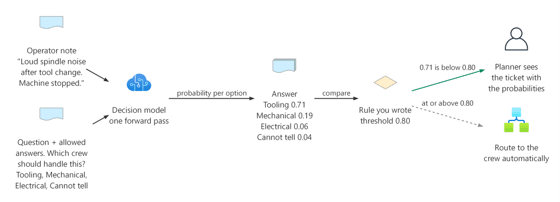

Figure 2. A generative model runs once per output token and hands you text to parse. A decision model runs once and hands you numbers.
Most disclosed decision models keep the body of an existing open LLM and swap its text-writing layer for one that scores options. AWS built Strands Decider that way on Qwen3.5-2B. OpenAI’s Decisions API is an interface rather than a model. It reads probabilities out of the general GPT model by a method OpenAI has not published, and TypeSafe has not said how Jev works either. By mid-October an independent inventory listed at least 26 models. Every product takes the same request shape, so moving between vendors takes little code. The answers do not move with you. When Texas State University researchers swapped the yes and no labels on the same questions, hosted Jev changed about half its answers, while open models trained for decisions held up far better. Test each product on your own cases before you choose one.
Where it goes in the plant
Most plant designs published so far put the model in the same place: between the code that detects an event and the person who signs off on what to do about it. Detection and arithmetic stay in your sensors, PLCs and whatever ML you already run. The decision model reads the text that arrives with the event and hands back a typed answer with a probability. A rule you wrote compares that probability to a threshold and acts only when it clears. Everything else, along with any case where a wrong answer would cost real money, goes to a person. Hivekit, which builds rules platforms for mines, puts it in one line: “Calculate what can be calculated. Use AI to interpret what can’t.”
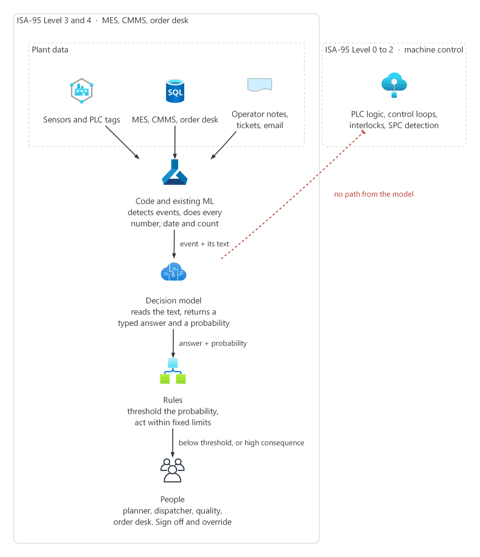
About four in fifteen published plant-adjacent builds break that split and hand the model a number or a control action. EMQX, an IoT vendor, documents a feature that lets the model pick a device command and a setpoint from a person’s request and send it straight to the device. I would not copy that design. A GitHub benchmark ran 975 Boolean expressions over PLC tags through plain code and through several decision models. The code got every one right in a fraction of a millisecond. Hosted Jev and Microsoft-Decision-1 scored about 99 percent, each with a network round trip. A local 2B model scored 78 to 79 percent. Control loops, PLC logic and SPC detection belong in code.
Where it fits and where it does not
| Verdict | Use | Condition |
|---|---|---|
| Fits | Downtime reason coding, maintenance ticket routing, nonconformance intake | Calibrate on a labeled plant sample. Add an abstain option. Queue low-confidence cases for a person. |
| Fits | Order desk: RFQ triage, account and job matching | Code does extraction and arithmetic. Export-control and end-use questions stay with a person. |
| Fits | Gating ahead of an expensive LLM call | Cost saving only. The fallback must bring different evidence, not a second model reading the same text. |
| Conditional | Interpreting an alarm after code has detected it | Context must be current. A safe default route when the model is unreachable. Local placement for alarm floods. |
| Conditional | Dispatch and readiness scores for schedulers | Include a hold option. Show the probabilities to the dispatcher. The optimizer stays in charge. |
| Conditional | Branch points inside shop-floor agents | Tool choice and routing only. No automatic execution without a rule gate. |
| Not yet | Quality disposition, batch release, CAPA | Regulated decisions stay with qualified people. Untested under GMP, FDA or IATF 16949. |
| Not yet | Visual inspection as the primary inspector | At most a second opinion on images a trained model has already flagged. |
| Never | Control loops, PLC logic, numeric rules, SPC detection | Use code or an embedded trained model. |
Table 1. How each use fits as of October 2026, based on published tests and vendor documentation.
What the published tests show
Against a hosted LLM, it is faster and cheaper at slightly lower accuracy. In the Artificial Analysis Decision Index, Jev took 0.13 seconds per task against 1.4 seconds for Claude Haiku 5.5, at $42 per million tasks against $184. Haiku scored three index points higher. Artificial Analysis sells benchmark data.
Where you already have labels, a trained classifier usually wins. At a 0.5 percent false-alarm budget, Cisco’s model trained on its own policy caught 61 percent of target cases against Jev’s 34 percent. Red Hat’s self-hosted 35B LLM matched or beat Jev, while its 3B and 4B models did not. Cisco and Red Hat both sell classifiers. Rerun the comparison on your own data.
The one manufacturer test is encouraging and small. Mainrich International, a magnet maker, ran Jev on eleven invented order-desk messages. At thresholds of 0.98 and 0.90, one settled with no person involved and none was filed to the wrong job. Mainrich judged RFQ triage “the strongest fit,” kept quote arithmetic in code and left export-control questions with a person.
The reason to look at a decision model is that it needs no labeled history to start. It gives you a typed answer out of text you have never labeled, faster and cheaper than a hosted LLM. Once you hold labels, or already host a 35B-class LLM, that advantage shrinks.
Three traps, all in the threshold
The threshold nobody measured. Every plant design gates on the probability. Most set the cutoff by hand, between 0.60 and 0.98, and none has reported recalibrating it on plant data. In one field test 51.5 percent of Jev’s answers were exactly 1.0, which leaves a threshold nothing to rank.
Answers that move with the wording. In a defect-cause test, moving an “Undecided” option from the end of the list to the start cut its probability from 31 percent to 2.3 percent. The question, its options and its threshold are plant configuration and need the change control you give an alarm setpoint.
Confident errors pass straight through. A threshold admits what the model is surest of, wrong answers included. A University of Pennsylvania study found LLM judges agreed with Jev’s most confident errors 96 percent of the time, against 50.3 percent expected by chance, so escalating to a larger LLM does not catch them. The fallback must bring different evidence: a person, a measurement or an MES lookup.
Two more constraints apply. The flagship hosted models, including Jev, Microsoft-Decision-1 in Microsoft Foundry and OpenAI Decisions, list no on-premises option, and TypeSafe’s status page showed six incidents between 20 September and 14 October. The models return no rationale, so your integrator builds the audit record, and none has been validated under GMP, FDA or IATF 16949.
How to find out whether it fits your plant
Pick the use and label the cases. Choose work at ISA-95 Level 3 or 4 where the text is short, the label set is closed, the volume is high, and a person can undo a wrong answer. Downtime reason coding, maintenance ticket routing, nonconformance intake and RFQ triage all qualify. Pull 20 to 50 real cases and label them. Without that sample, thresholds “have no meaning,” as JodyCraft, a former inspection engineer, wrote after surveying plant use cases.
Run three candidates on the same sample. Write the question with an abstain option such as insufficient_evidence, and keep every number, date and count in code. Run a hosted decision model, a trained classifier and an LLM you host yourself. Measure accuracy, calibration, the share of answers at exactly 1.0, and tail latency, not only the median. Then swap the option order and repeat identical calls to measure how far the answers drift.
Run a silent phase, then set thresholds. Let the winning candidate answer live traffic while nothing acts on it. OmniMES proposes two weeks. Set thresholds from what you measured, with a margin, and start conservative. Pin the model version. Log every decision: the input, the question and options, the probabilities, the threshold, the action and who acted.
Before any plant data leaves the site, read the vendor’s terms on retention and processing location. Where data cannot leave, Laya, GLiNER2.5-Decide, Strands Decider 2B and Clef ship open weights under Apache-2.0, and Laya runs through the llama.cpp decision endpoint.
To read further: the Artificial Analysis Decision Index for cross-vendor benchmarks, Sebastian Raschka’s history of text classification for how this relates to what came before, Microsoft’s Foundry deployment guide for Azure customers, and the Mainrich write-up for a manufacturer’s published results.
Twenty to fifty labeled cases and a silent phase will tell you whether a decision model fits your plant.
About the Author
Erik Benjaminson is a Senior Architect at Covenant Technology Partners with nearly 30 years of experience across enterprise technology, consulting, software engineering, solution architecture, and AI. His background includes 14 years at Microsoft, along with leadership and architecture roles at NetApp and F5. Today, his work focuses on turning emerging AI technologies into practical, production-ready systems that solve real business problems.
Connect with Erik on LinkedIn.